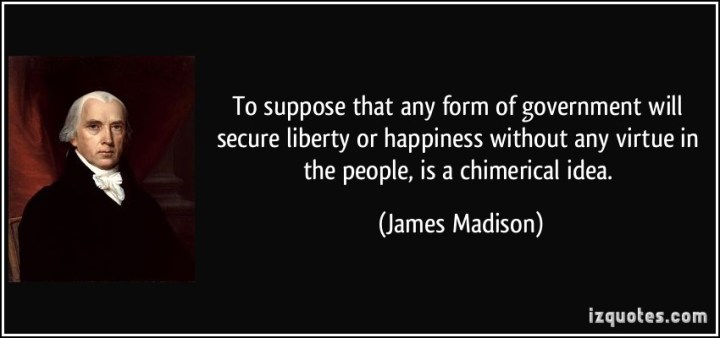
Liberty and happiness have become morally neutral. Freedom has come to mean that a person may choose what he or she values irrespective of the impact that the choices may have on the community, and no one should be encumbered by another’s vision of the good life. The idea that self-government ensured liberty, but that self-government was completely dependent upon virtuous citizens and representatives has been lost. For the Founders, the quality of the citizen participants in the great American experiment in good government was key. The best government could only happen if the participants were made of superior stuff. In order for citizens to participate in a system of government that would make good laws, they must possess the wisdom and moral strength to make good decisions, and also the understanding that the good life has a social context.
Madison wrote that “virtue is the vital principle of a republic, and it cannot long exist without frugality, probity, and strictness of morals.”[1] Self-regulation was the key to living free. Without a constancy of effort to live a life of virtuous moderation all would collapse into chaos and licentiousness. If good behavior will not come from within, then it must come from an external source: government.
Virtue is so far gone from our modern theory of liberty that we no longer mourn the loss. We celebrate the unfettered expansion of personal choices while acquiescing to the fact that it has become the responsibility of an enlarged government to determine the limits. The good life has been paradoxically both privatized and become the public responsibility.
In George Washington’s first inaugural address, he emphasized the vital connection between the public good and virtue. He was confident that “no separate views or party animosities” would prevent them from forming national policy on “the pure and immutable principles of private morality.”[2] According to Washington, America would win the respect of the world with the understanding that “there is no truth more thoroughly established than that there exists in the economy and course of nature an indissoluble union between virtue and happiness; between duty and advantage; between the genuine maxims of an honest and magnanimous policy and the solid rewards of public prosperity and felicity.”[3]
[1] James Madison, quoted in Michael J. Sandel, Democracy’s Discontent: America in Search of a Public Philosophy (Cambridge, Mass.: Belknap Press of Harvard University Press, 1996), 126.
[2] My Fellow Americans: Presidential Inaugural Addresses, from George Washington to Barack Obama (St. Petersburg, Fla.: Red and Black Publishers, 2009), 7.
 Character Mattered
Heather You have a marvelous vocabulary and a true sense of character and vision. Bob
Sent from my iPhone
>
LikeLike