The wisest and happiest government that human wisdom can contrive?

“But what is government itself,” asked James Madison, “but the greatest of reflections on human nature?”[1]

By the end of the American Revolution, a republic with a weak central authority had morphed from the loosely organized colonial congresses that had met to discuss grievances with England.  By 1789 a highly organized group of patriots determined “that there are important defects in the system” [2] and decided to take a closer look at how this loose confederation of states was organized and governed.  James Madison admitted that “what may be the result of this political experiment cannot be foreseen,”[3] as some of the most brilliant men to have ever lived at one time—Madison, Benjamin Franklin, Alexander Hamilton, James Wilson, John Dickinson, George Wythe—collected in Philadelphia to address the “defects.”  A little over three months later a freshly drafted Constitution was submitted to the states for ratification.  A new rule book… how a bill becomes a law… three branches of government… checks and balances…it all may seem a bit dry and just the boring stuff we had to memorize for social studies multiple-choice tests.

So, spend a moment reflecting on this passage written by the not often gleeful John Adams:

The happiness of society is the end of government, as all Divines and moral Philosophers will agree that the happiness of the individual is the end of man. From this principle it will follow, that the form of government, which communicates ease, comfort, security, or in one-word happiness to the greatest number of persons, and in the greatest degree, is the best…. All sober enquiries after truth, ancient and modern, Pagan and Christian, have declared that the happiness of man, as well as his dignity consists in virtue. Confucius, Zoroaster, Socrates, Mahomet, not to mention authorities really sacred, have agreed in this…. a form of government then, whose principle and foundation is virtue, will not every sober man acknowledge it better calculated to promote the general happiness than any other form?….  When! Before the present epocha, had three millions of people full power and a fair opportunity to form and establish the wisest and happiest government that human wisdom can contrive? [4] (emphasis added)

The men gathered in Philadelphia were keenly aware that they were not just rewriting a rule-book.  They were undertaking a project that had never before been attempted in human history.  In America, more people were granted personal and political freedom than had ever been experienced in human history with highest goal of creating on this wilderness continent the “wisest and happiest” society.

At the close of the constitutional convention Benjamin Franklin was supposedly asked about what type of government they had created, to which he responded, “a Republic, if you can keep it.”  We have not kept it.  Of course, the constitutional structure of government has remained but it does not function today as it was intended.  Blame is frequently placed on the degrading influence of money.  The chain of cause and effect, however, is more complex.

Money has corrupted the system because we no longer expect that virtue is the foundation of good government.  As a result, the lack of virtue in our political leaders, that was so important to the founders and was essential to the federalists’ argument, is no longer a central concern.  The value that was traditionally placed on virtue meant that the exercise of liberties carried with it some important responsibilities; this has also diminished.  Rather than virtue being the internalized force for good, the responsibility for maintaining the good life has been externalized and is now largely the responsibility of the national government.  The loudest voices (often funded by the largest bank accounts) determine the limits of what is acceptable.  Virtue had placed internal limitations upon the exercise of liberty and established an agreed upon standard of the good life.   The only true value that remains is an aggressively individualistic concern for personal freedom.

Today’s individualism has taken an ugly turn.   Personal fulfillment has ceased to be inextricably connected with the well-being of the community.   For the founders, the individualism that underpinned personal liberty was balanced by a concerned involvement with the community.  What it means to be connected to the community has radically changed.   The manner of relating to others through Facebook, Twitter, and Instagram is more about incessant self-defining than creating community.  Researchers in the social sciences have looked at the growing problems of social isolation that are accentuated through social media.[5]  In a recent meta-analysis, a strong connection was found between the use of social media, such as Facebook, and high levels of both loneliness and narcissism.  A bidirectional relationship was suggested with the characteristics leading to greater use of social media, and the greater use causing higher levels of distress.[6]  In the social media non-community there is communication without obligations of civility.  The Aristotelian virtue of moderation is never rewarded in an environment where outrage, novelty, and boundary pushing receives the most attention.

[1] Madison, James, “No. 51,” in The Federalist Papers: The Gideon Edition, ed. James McClellan and George W. Carey, Gideon ed. (Indianapolis: Liberty Fund, 2001), 269.

[2] National Archives, “Annapolis Convention. Address of the Annapolis Convention, (14 September 1786),” Founders Online, accessed March 9, 2018, https://founders.archives.gov/documents/Hamilton/01-03-02-0556.

[3] James Madison, “From James Madison to Thomas Jefferson, 19 March 1787,” Founders Online, last modified November 26, 2017, accessed January 25, 2018, https://founders.archives.gov/documents/Madison/01-09-02-0169.

[4] Adams, “Thoughts on Government.”

[5] See for example Sherry Turkle, Alone Together: Why We Expect More from Technology and Less from Each Other (New York: Basic Books, 2001).

[6] Dong Liu and Roy F. Baumeister, “Social Networking Online and Personality of Self-worth: A meta-analysis,” Journal of Research and Personality 64 (October 2016).

“Enlightened statesmen will not always be at the helm,” –James Madison, “No.10,” The Federalist Papers

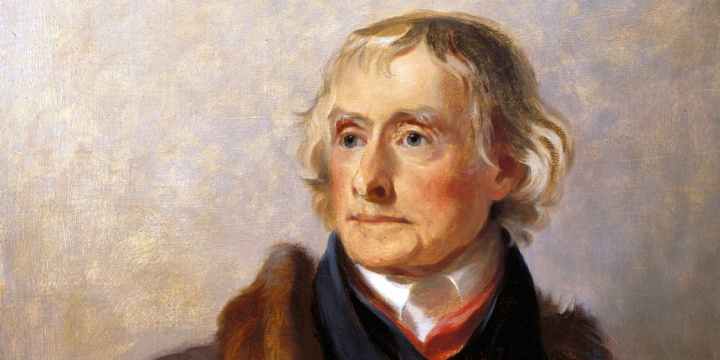
Lamenting the “dilatoriness of Congress” Thomas Jefferson asked, “how can expedition be expected from a body which we have saddled with a hundred lawyers, whose trade is talking?”[1]

Jefferson

[1] “Thomas Jefferson to Thomas Leiper, 12 June 1815,” Founders Online, National Archives, last modified June 13, 2018, http://founders.archives.gov/documents/Jefferson/03-08-02-0431. [Original source: The Papers of Thomas Jefferson, Retirement Series, vol. 8, 1 October 1814 to 31 August 1815, ed. J. Jefferson Looney. Princeton: Princeton University Press, 2011, pp. 531–534.]

Happy Constitution Day! September 17

“We have now the Honor to submit to the Consideration of the United States in Congress assembled that Constitution which has appeared to us the most advisable”[1]

—George Washington, in a letter to the Confederation Congress that accompanied a copy of the new Constitution, September 17, 1787

 We view the men who gathered to write the Constitution as some of the greatest heroes of American history and the document they produced as the best that could be created by the mind of man. In honor of Constitution Day, I’m using this space today to view the Constitution from a different perspective.  In what ways did they go wrong?  Were the ones who were vehemently against the Constitution the ones who possessed the clearest vision of America’s future? 

The United States Constitution is the longest surviving written constitution in history.  Around the globe it has been adopted as a template for good government.  It can therefore be difficult to understand how the Constitution could have been ratified by only the thinnest of margins and that many of the earliest reviews regarded it as a calamitous threat to liberty.  Of the original fifty-five delegates to the Constitutional Convention, just forty-two were there at the close, and only thirty-nine agreed to sign the document.[2]  Rhode Island refused to participate in the convention that produced the Constitution, and two of New York’s delegates left in disgust leaving the state unable to register a vote.

Upon first inspection of the Constitution, Thomas Jefferson’s response was hesitant at best. “There are very good articles in it: and very bad” wrote Jefferson, “I do not know which preponderate.” [3]   He believed that the writing of a new constitution had been an overreaction to a violent rebellion in Massachusetts and “in the spur of the moment they are setting up a [hawk] to keep the hen yard in order.”[4]  Many of Jefferson’s fellow Virginians were less equivocal in their assessments.   “I feel it among the first distresses that have happened to me in my life” wrote Richard Henry Lee to George Washington “that I find myself compelled by irresistible conviction of mind to doubt about the new System for federal government… I am led to fear the danger that will ensue to Civil Liberty from the adoption of the new system.”[5]  Patrick Henry declared that the Constitution had many “deformities” and that “it has an awful squinting; it squints towards monarchy.”[6]  Before the ink had dried on the new Constitution, George Mason dramatically declared that he would rather cut off his hand than sign the document.

In the four most populous states in the Union, there was strong resistance to ratification.  The Pennsylvania convention suppressed all debate and after a vote to approve the Constitution there was wild talk from the western parts threatening violence and secession.  In the early days of the Massachusetts convention the majority of the three-hundred-fifty delegates were against ratification.  There were fist-fights, traded insults, and passionate speeches that ultimately brought enough of the delegates around for a vote in favor of the Constitution by a mere nineteen votes.  The hostile resistance to the Constitution in New York and Virginia was only overcome after assurances that the first order of business would be to attach the amendments that are now known as the Bill of Rights.

When the Constitution is discussed today the focus is on how it should be interpreted.  Supreme Court justices are classified as textualist, originalist, living constitutionalist, and so on into ever more obscure divisions.  It is important to take one step back from these arcane controversies to understand what animated those who were involved in the first round of debate over the Constitution.  Interpretation of the Constitution is secondary to the issue of why it was written in the first place.  The United States’ first attempt at government—the Articles of Confederation—appeared to have failed and needed to be replaced. What had gone wrong and what was the cure?  Might the medicine be too strong?

The central disagreement between the Constitution’s advocates and opponents—the so-called federalists and antifederalists[7]–was how liberty was to be protected: weak or strong government?  Both sides knew what the most important ingredient was for liberty to flourish: virtue.  The federalists believed, and their arguments ultimately prevailed, that the Articles had failed because American citizens were just not virtuous enough.  In their view, people had proven to be self-indulgent and careless of the nation’s collective welfare.  The people were lacking in the most important virtues.  They were not moderating their passions, they were dishonoring justice, disrespecting the laws, disregarding the public welfare, and they were not exercising wisdom when electing state representatives.

If virtue was not as widespread as the founders had hoped, then the survival of the nation would require a strengthened government.  Government would have to assume a larger responsibility to make people behave.  The strengthened national government would prevent the “corruption of manners,” that was threatening the young republic, wrote John Dickinson of Pennsylvania, and that it would be nothing less than a “crime to be equaled only by its folly” for the Constitution not to be ratified.[8]   Liberty was being destroyed by “the licentiousness of the people, and turbulent temper of some of the states.”[9]  The idealized free citizen was virtuous and self-regulating, and experienced his God-given personal and political freedom in a socially productive manner.   Virtuous citizens possessed the self-regulation to exist comfortably and securely under the auspices of the relatively light-hand of government.  According to the federalist, this had been an unrealistic expectation.

The federalists’ argument represented a new perspective on virtue and rested upon the premise that the power placed in the national government was less likely to be abused than it had been in the state governments.  Through enlarging the sphere of government, the ability for the unvirtuous rabble to exert a harmful influence would be limited.  The burden of virtue was shifted from the regular citizen to the leadership.  The revised federal system was designed in such a way so that the virtuous elite could be lifted above the hoi polloi in the states and granted greater authority in the national government. Men selected to govern under the proposed Constitution would be more virtuous, more trustworthy, and more rational, than the average man.  Whereas Locke had established the rationale and expectations for government, the federalists raised the stakes for what it meant to be a leader.  Their writings represented a theory concerning lowered expectations of virtue in the citizenry and a return to the ancient Greek and Roman idealization of the leader.

The virtue of the common people became less important as it was assumed that a natural aristocracy would flourish, particularly in the senate and the presidency.[10]  This was a model of leadership that was expressed in the Roman legend of Cincinnatus, a virtuous leader who gave up the opportunity to be a dictator in order to return to modest life on the farm.  Many of the founders’ heroes had been Athenian aristocrats who had tried to contain the vices of the people.  Solon, for example, was often praised by the founders as the model of wisdom and moderation.  The most romanticized of all their heroes were Cato the Younger, Brutus, Cassius, and Cicero; all of whom were hero-worshiped for their selflessness and struggles to protect liberty.[11]  The convention that produced the Constitution, according to Alexander Hamilton, had been composed of men of unimpeachable good character, “who possessed the confidence of the people, and many of whom had become highly distinguished by their patriotism, virtue, and wisdom, in times which tried the souls of men, undertook the arduous task… they passed many months in cool uninterrupted and daily consultations…. without having been awed by power, or influenced by any passion, except love for their country.”[12]

One of the many advantages of having a centralized government was that it could “collect and avail itself of the talents and experience of the ablest men, in whatever part of the union they may be found.”[13]  Numerous features within the Constitution would ensure that men of talent and integrity would be selected to serve.  “There are strong minds in every walk of life, that will arise superior” wrote Hamilton “and will command the tribute due to their merit.”[14]  The new constitution not only created a national government where the more virtuous leaders would be lifted above the common man, but the federalists believed the common man could be quite feckless and their voices needed to be muffled.

The expectation that the Senate would proceed with more “coolness” and “wisdom than the popular branch was a reason given for keeping the numbers small, for to “enlarge their number and you communicate to them the vices which they are meant to correct.  The more the representatives of the people therefore are multiplied, the more they partook of the infirmities of their constituents.”[15]  By setting an age qualification at thirty-five “it confines the elections to men of whom the people have had time to form a judgment…who best understand our national interests… who are best able to promote those interests, and whose reputation for integrity inspires and merits confidence.”[16]  When it came to the selection of officers to serve on the Supreme Court, the method of appointment by the president and approval by the Senate as opposed to leaving it the judgement of the people, assured that only the properly prepared would serve.   In choosing people to serve in the judiciary branch it was of particular importance that it not be left to the people at large.[17]

In defending the method of appointment for the president, there was particular effort to assure that the vices of human nature could be circumvented.  The system of selecting the electors would ensure that the “sense of the people” would be felt but that “tumult and disorder” would be avoided.  The “detached and divided” manner in which the electors would cast their votes “will expose them much less to heats and ferments” and “cabal, intrigue, and corruption” would be avoided.[18] Hamilton predicted that “this process of election affords a moral certainty, that the office of president will seldom fall to the lot of any man who is not in an eminent degree endowed with the requisite qualifications… It will not be too strong to say, that there will be a constant probability of seeing the station filled by characters preeminent for ability and virtue.”[19]

The president would enjoy a serene separation from the people and remain above any prevailing “ill-humors” in society.  Hamilton stressed that the president would not be influenced by “every sudden breeze of passion, or to every transient impulse” that may activate the people.”[20]  The people may succumb to “the wiles of parasites and sycophants, by the snares of the ambitious, the avaricious, the desperate, by the artifices of men who possess their confidence more than they deserve it” but it was the “the persons whom they have appointed to be the guardians of those interests, to withstand the temporary delusion, in order to give them time and opportunity for more cool and sedate reflection.”[21]

The structure of the Constitution was evidence of the diminished expectation that liberty would only flourish if the citizens were virtuous.  The degree of political liberty that citizens had enjoyed during the period of the Confederation was reined-in as their influence on the three branches of government was minimal.  Happiness, understood as behaving in a moderate style, had been the highest goal that would lead to a harmonious community.  The lynchpin of liberty—virtue-based happiness among the people at large—did not seem to be adequately widespread, and so the country adopted a new constitution.

The federalists thereby contextualized the problem of virtue in a new way.  Due to a lack of virtue, the people were not fit to hold the unfiltered power that they had abused under the former style of government.  There existed a positive correlation between virtue and ability to rule and it had become alarmingly apparent that nature had not been equitable in her distribution.  In Hamilton’s forthright manner of stating the problem, he reminded his readers of the tendency for the people to be “ambitious, vindictive, and rapacious.”[22]  For the benefit of the common welfare, certain features of the invigorated national government would result in the selection of leaders with greater wisdom and better qualifications than had been the rule in the state legislatures.  Though Madison admitted that “enlightened statesmen will not always be at the helm,”[23] he expected to find more men of good character in the rarified offices of the national government, particularly in the senate and the presidency, than in the state legislatures.  In addition, the method for determining who would serve would allow for increasing levels of detachment from, and thereby the ability to resist, the impulsive, ignorant and leading-to-tyranny passions of the people.

The antifederalists rejected the theory that checks and balances among the three branches of the national government would protect the liberty of the people or prevent an unlimited increase in the size and power of the national government in relation to the states.  The equilibrium among the three branches would not last and power would eventually “preponderate to one or the other body,” this would cause an eventual accumulation of all power in one branch.[24]  The antifederalists presciently observed how both Congress and the Supreme Court would expand their powers overtime.  Article I, Section 8, Clause 18 gave Congress power “to make all Laws which shall be necessary and proper for carrying into Execution the foregoing Powers, and all other Powers vested by this Constitution in the Government of the United States, or in any Department or Officer thereof” and would be used to expand the powers of taxation for any purpose that might “be for the general welfare.”  It was impossible to have a clear understanding of how far the powers could be stretched in the future. “or of the extent and number of the laws which may be deemed necessary and proper.”  The people might hope “that a wise and prudent congress will pay respect to the opinions of a free people… but a congress of a different character” might not respect those principles.[25]

The antifederalists placed little faith in the virtuous self-restraint or good character of future leaders as they pondered the meaning of “necessary and proper.”   Future administrations would probably look to expand their influence and “take every occasion to multiply laws, and officers to execute them, considering these as so many props for its own support.”  Taxes would be increased “to support the government, and to discharge foreign demands.”[26]  “The expense of the new plan [was] terrifying” with all the new complexities and inconveniences created by expanding the national level of government.[27]

The Supreme Court and the Senate would certainly expand their power.  Armed with the knowledge of how the courts in England with “ingenious sophisms” had expanded their authority, it was predicted that the judicial branch would also extend “the sphere of influence.”[28]  The term of six years with no term limits for senators would make it probable, “from their extensive means of influence,” that they would continue in office for life.  The entire plan of government, therefore, was certainly going to result in “a permanent aristocracy.”[29]  Contributing to the foreseeable increase in the power of the national government was the complexity of the system.  “If you complicate the plan by various orders, the people will be perplexed… about the source of abuses or misconduct” and the judgment of the people will be inoperable.  The protection of liberty required that the sources of abuse be easily identifiable and that short terms in office will permit the people to quickly discard them at the next election.[30]

[1] “From George Washington to the President of Congress, 17 September 1787,” Founders Online, National Archives, last modified June 13, 2018, http://founders.archives.gov/documents/Washington/04-05-02-0306. [Original source: The Papers of George Washington, Confederation Series, vol. 5, 1 February 1787 – 31 December 1787, ed. W. W. Abbot. Charlottesville: University Press of Virginia, 1997, pp. 330–333.]

[2] The Constitution ends with the disingenuous statement “By the unanimous Order of the Convention.”

[3] “From Thomas Jefferson to William Stephens Smith, 13 November 1787,” Founders Online, National Archives, last modified June 13, 2018, http://founders.archives.gov/documents/Jefferson/01-12-02-0348. [Original source: The Papers of Thomas Jefferson, vol. 12, 7 August 1787 – 31 March 1788, ed. Julian P. Boyd. Princeton: Princeton University Press, 1955, pp. 355–357.]

[4] Ibid.

[5]  Richard Henry Lee, “To George Washington from Richard Henry Lee, 11 October 1787,” Founders Online, last modified November 26, 2017, accessed January 25, 2018, http://founders.archives.gov/documents/Washington/04-05-02-0336.

[6] Patrick Henry, “Speeches of Patrick Henry in the Virginia State Ratifying Convention, 5 June 1788,” The Anti-Federalist, 310.

[7] Both groups agreed that maintaining a federal form of government, that is a structure that shared power between the states and a central authority, was important.  To be accurate therefore, to refer to the group that was against ratification as anti-federalists was a misnomer.  In this writer’s opinion, better names for the two would have been nationalists and anti-nationalists.

[8] John Dickinson, “The Letters of Fabius in 1788 on the Federal Constitution, Letter VIII,” ed. Paul L. Ford, Internet Archive, accessed March 9, 2018, https://archive.org/stream/lettersoffabiusi00dickuoft/lettersoffabiusi00dickuoft_djvu.txt.

[9] John Dickinson, “The Letters of Fabius in 1788 on the Federal Constitution, Letter VII” ed. Paul L. Ford, Internet Archive, accessed January 19, 2018, https://archive.org/stream/lettersoffabiusi00dickuoft/lettersoffabiusi00dickuoft_djvu.txt

[10] See David R. Weaver, “Leadership, Locke, and the Federalist,” American Journal of Political Science 41, no. 2 (April 1997).

[11] Carl J. Richard, The Founders and the Classics: Greece, Rome, and the American Enlightenment (Cambridge, Mass.: Harvard University Press, 1995), 55-57.

[12]  Hamilton, “No. 2,” The Federalist Papers: The Gideon Edition, ed. James McClellan and George W. Carey, Gideon ed. (Indianapolis: Liberty Fund, 2001), 7.

[13] Jay, “No. 4,” The Federalist, 15.

[14]  Hamilton, “No. 36,” in The Federalist, 173.

[15] James Madison, “Remarks in the Federal Convention on the Senate (June 7, 1787),” in James Madison: Writings, 98.

[16] Ibid.

[17] Madison, “No. 51,” in The Federalist, 268.

[18] Hamilton, “No. 68,” in The Federalist, 354

[19] Ibid., 354.

[20] Hamilton, “No. 71,” in The Federalist, 370.

[21] Ibid.

[22] Hamilton, “No. 6,” in The Federalist, 21.

[23] Madison, “No. 10.” in The Federalist, 45.

[24] “Centinel, Letter I (October 1787),” in The Anti-Federalist: Writings by the Opponents of the Constitution, ed. Herbert J. Storing and Murray Dry, (Chicago: Univ. of Chicago Press, 1985),  15.

[25] Federal Farmer, “Letter IV (October 12, 1787),” in The Anti-Federalist, 56.

[26] Federal Farmer, “Letter III (October 10, 1787),” in The Anti-Federalist, 49.

[27] Agrippa, “To the People (23 November 1787),” in The Anti-Federalist, 230.

[28] “Centinel, Letter I (October 1787),” in The Anti-Federalist 17.

[29] Ibid., 19.

[30] Ibid., 16.
 

Happiness

The Declaration of Independence is the most read, listened to, and celebrated of our nation’s foundation documents.  The common title for the Declaration, however, is an unfortunate misnomer and misdirects our attention.  Jefferson’s original title was: A Declaration by the Representatives of the United States of America, in General Congress Assembled.  The title of the document held at the National Archives is The Unanimous Declaration By the Thirteen United States of America.  In some of the earliest reprints the words “Unanimous” and “Thirteen” were dropped.    The fact that “Independence” was never part of the original title is not a trivial point.  It would be more to the point to call it The Declaration of Liberty; for that was the cause that the founders were most vehemently declaring.

In the Gettysburg Address, Abraham Lincoln directed the nation’s attention to the Declaration’s assertions of liberty and equality.  A focus on political independence, or a reminder of the right of a “people to dissolve the political bonds which have connected them with another” and assume “the separate and equal station to which the laws of nature and of nature’s God entitle them” would have been awkward to say the least.  After all, independence was what the Confederates were fighting for. The Declaration has continued to inspire freedom seekers, and not necessarily independence seekers, from around the world, and from the most dissimilar political philosophies, such as the French revolutionaries of 1789 to Ho Chi Minh and Beijing’s Tiananmen Square protesters.  Alexis de Tocqueville, that astute observer of the early United States, wrote that the American Revolution was “produced by a mature and thoughtful taste for liberty, and not by a vague and undefined instinct for independence.”[1]

In June of 1776, Richard Henry Lee’s Resolution for Independence concisely stated the Second Continental Congress’ view of the facts: the colonies were free and independent.  The revolutionaries, however, were not just political architects who were deconstructing one system and constructing a new model of government.  They were political philosophers engaged with the biggest question: how are people supposed to live?  That was why Jefferson went well beyond Lee’s straight forward statement to assert a few cardinal truths concerning human values when he wrote the Declaration.  To be free to pursue happiness was the ultimate purpose of life.

In the Declaration, the word “happiness” appeared two times and was the climactic word that ended the sentences where it was used.  As both a musician and an architect, Jefferson was acutely attuned to the importance of repetition.   The rhythm and design of his sentences were well thought out, particularly since Jefferson wrote the Declaration to be read aloud.  He was aware of the stylistic importance of placing the emphatic word at the end of the sentence.  If we imagine Jefferson putting those two sentences to music, one can almost see the crescendo symbols beneath the two stanzas.  As Jefferson’s biographer Dumas Malone wrote: “He was a ready writer but he could also be a fastidious one, and he never weighed his phrases more carefully than now.”[2]  The Declaration underwent extensive editing before it was approved by Congress, with some twenty-six major alterations and two new paragraphs added.  Jefferson’s statements about rights and happiness, however, remained untouched.[3]

As asserted in the Declaration, we have many inalienable rights, hence the use of the phrase “among these;” but Jefferson chose the most fundamental to spell out.  People must be able to preserve their life, they must be free to control the direction of their life, and if these two rights were secured, they would be able to pursue the ultimate goal of happiness.  Life and liberty were the means to the end state of happiness.  When Jefferson wrote of happiness he presented what might initially appear to be a conflict over how happiness was connected to a meaningful life.  It was potentially paradoxical because with the dual mentions in the opening paragraph of the Declaration, each time it seemed to present a different perspective.

In the first use of the word it appeared as though happiness was an individual and private matter in that all men were “endowed by their Creator with certain inalienable Rights, that among these are life, liberty and the pursuit of happiness.”  The implication was that the maintenance of rights was for the benefit of the individual.  As long as a person was in possession of his life and was at liberty, he could pursue his own idea of happiness.  Toward the end of the paragraph the meaning shifts.  Happiness was a goal that was to be achieved collectively through the community and was the government’s responsibility.  The Declaration stated that “the People” will create new governments “as to them shall seem most likely to effect their Safety and Happiness.”   It could not possibly be a purely private and subjective matter if the ultimate goal of government was to secure happiness for the general population.  If each person was at liberty to self-define his ideal end state then one person’s idea of happiness might conflict with another’s.  In a situation where the maintenance of happiness was to be achieved by the collective action of government, there must be an agreed upon definition of this happiness experience that everyone was pursuing.  The notion that the people will create governments that will both ensure safety and promote happiness was yet another idea potentially loaded with problems.

Much of the past two-hundred plus years of political debate has been a wrangling over the problem of the seemingly zero-sum game between liberty and security.  If all are completely free there is no security so we give up some liberty with the hopes of finding some security.  How much freedom to give up for how much safeguarding?  More than two-hundred years of intense and often hostile political debate in the United States has not answered that question.  On the other hand, if the citizenry shared a vision of happiness that was based on an agreed upon definition of the good life that all clear-thinking people would choose, conflict could be minimal.  This idea of a communal or public happiness was an idea that was expressed by Jefferson in one of his few published documents.  In A View of the Rights of British America published in 1774, Jefferson wrote of a peoples’ right to “establish new societies, under which such laws and regulations as to them shall seem most likely to promote public happiness (italics added).”[4]

Jefferson never clearly explained what or who inspired his use of the word “happiness.” In fact, if Jefferson’s use of the word was unusual, then we might be inclined to dismiss the usage and attribute it to some sort of Jeffersonian eccentricity.  Its prominence in the Declaration, however, was not a deviation from the norms of his day.  Both before and after the printing of the Declaration, the word happiness was regularly used when discussing the goal of government.  The strength of the Declaration was that it stated what everyone already agreed to be true, or as John Adams wrote in his own prickly sort of way, “there is not an idea in it but what had been hackneyed in congress for two years.”[5]

Happiness was a familiar theme in many of the most well-known writings of the day.  The popular Reverend Jonathan Mayhew of Boston preached in 1754 that the purpose of government was the happiness of men.   Although Jefferson claimed not to have read his pamphlet, in 1764 James Otis wrote that the end of government was “to provide for the security, the quiet, and happy enjoyment of life, liberty, and property.”[6]   In 1765, the Continental Congress  asserted, “that the increase, prosperity, and happiness of these colonies depend on the full and free enjoyment of their rights and liberties.”[7]  Jefferson most certainly read the widely circulated work written in 1768 by a man he admired enormously, Joseph Priestly.  Priestly wrote, “that the happiness of the whole community is the ultimate end of government can never be doubted… The great object of civil society is the happiness of the members of it.”[8]

Josiah Quincy wrote in 1774 in an essay, Observations on the Act of Parliament Commonly Called the Boston Port-Bill, that the utilitarian objective of civil society was “the greatest happiness of the greatest number.”[9]  In response to the congressional delegates looking for guidance in writing state constitutions, in April of 1776 John Adams wrote Thoughts on Government, where he asserted that “the happiness of society is the end of government.”[10]

In the years immediately preceding the Declaration, numerous essays appeared in the Virginia Gazette with titles such as “The Pursuit of Happiness,” “Happiness,” “Essay on Happiness,” and “The Character of the Happy Life.”  All of these essays connected happiness with virtue.[11]  Fresh in Jefferson’s mind as well, must have been the widely read and commented upon pamphlet Considerations on the Nature and Extent of the Legislative Authority of the British Parliament, written in 1774 by James Wilson, one of the most highly respected legal scholars in the colonies.  He expressed ideas, as well as the paragraph structure, that will reemerge in the Declaration: “All men are, by nature, equal and free: no one has a right to any authority over another without his consent: all lawful government is founded in the consent of those who are subject to it: such consent was given with a view to ensure the happiness of the governed…. The consequence is, that the happiness of the society is the first law of every government.[12]

The most frequently cited source for Jefferson’s statement on rights was from his friend and fellow Virginian, George Mason.  In June of 1776, the Virginia Constitutional Convention approved “A Declaration of Rights” that had been written by Mason.  All men were “by nature equally free and independent and have certain inherent rights,” and they must never be deprived of “the enjoyment of life and liberty, with the means of acquiring and possessing property, and pursuing and obtaining happiness and safety.[13]

Mason’s emphasis on happiness can be traced to an earlier reference from 1774, when he penned the Fairfax County Resolves.  He wrote that people are only to be governed by laws passed by elected representatives, and that the laws must protect the “safety and happiness” of the community.[14]  Virginia’s “Declaration of Rights” appeared in the Pennsylvania Gazette on June 12, 1776, the same day Congress appointed the committee of five to write the Declaration.  We will never know, but we might safely assume, that Mason’s Declaration was discussed.  What, after all, could have been of greater interest to Jefferson than what was coming out of the Virginia Constitutional Convention?  It is likely that Mason’s words were fresh in Jefferson’s mind, and it is very possible that a copy of Mason’s Declaration was close at hand.

The similarities between Mason’s and Jefferson’s Declarations are indeed striking. It is also interesting to explore the words that Jefferson decided to exclude.  Mason wrote of the rights of “pursuing and obtaining happiness and safety.”  Jefferson dropped safety, perhaps believing that safety was already covered by the right to preserve one’s life.  Jefferson also seemed to believe that we have a right to pursue happiness, but no right to necessarily obtain it.  With this, Jefferson was reaching back to the Aristotelian view of happiness: it was a life well lived and dependent on a person’s efforts at a virtuous life as well as the individual’s ability to maximize inherent capacities.  Jefferson corrected Mason’s error.  It was entirely within a person’s own power to become virtuous and no government could make sure a person obtained it.  Mason appeared to be the bridge between John Locke and Jefferson concerning the issue of property and happiness.  Mason included both “property” and “happiness” in his statements.  Jefferson chose to drop “property” and single out “happiness.”

Historians debate which philosopher may have influenced Jefferson more, yet most Declaration scholars recognize the clear influence of John Locke.[15]  The notion that freedom and happiness was inseparably linked to the protection of property and was therefore the primary object of government was Locke’s essential thesis.[16]  Nonetheless, Jefferson was never attached to any one philosophical creed.  He drew from a deep well of often competing philosophical schools, such as the Cynics, Stoics, and Epicureans; he was fascinated by Socrates, Cicero, Seneca, and Tacitus.[17]

In 1825, the aging Jefferson recollected that when he wrote the Declaration he had been influenced by “the harmonizing sentiments of the day, whether expressed in conversation, in letters, printed essays, or in the elementary books of public right, as Aristotle, Cicero, Locke, Sidney, &c.”[18]  Even if we were to concede that Jefferson’s list was chronological—ancient Greece, ancient Rome, Enlightenment—the preeminence of Aristotle’s views on the connections between politics and ethics had a tremendous impact on the Enlightenment thinking that Jefferson assimilated and articulated.[19]  The Declaration was the eighteenth-century culmination of two thousand years of thinking about the human condition that begins with Aristotle’s systematic presentation of his view that politics and ethics were not  two distinctly separate areas of study.[20] According to Aristotle “We took the end of political science to be the chief good, and political science is concerned most of all with producing citizens of a certain kind, namely, those who are both good and the sort to perform noble actions” (NE I.9.1099b29-32).  When Jefferson wrote that happiness was the ultimate aim of human life it was an expression of Aristotle’s understanding of happiness (eudemonia) as a style of virtuous living, well-being, or flourishing that could be judged objectively.

We honor the Declaration without realizing how profoundly this nation has disconnected from the original meaning of the words that the document celebrated.  The National Archives can preserve the parchment, but the conceptual additions and subtractions from mental constructs can happen slowly and outside of awareness as a result of human experience.  Modern definitions of happiness reference subjective emotional states such as joy, merriment, and cheerfulness.   Happiness had become a private, affective state that could only be judged individually; an idea we are more familiar with today.  Within the brain, it is a limbic system (often called the mammalian brain) dominated experience.   The founders meant for it to mean much more.

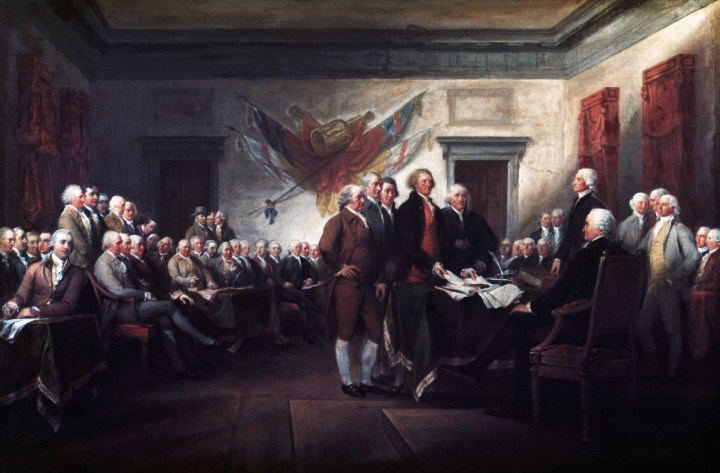
declaration-of-independence-july-4-painting


[1]  Alexis de Tocqueville, Democracy in America, trans. James T. Schleifer, ed. Eduardo Nolla, English ed. (Indianapolis: Liberty Fund, 2012), 1:117.

[2] Dumas Malone, Jefferson the Virginian, vol. 1, Jefferson and His Time (Boston: Little, Brown and Company, 1948), 221.

[3] Carl Becker, The Declaration of Independence: A Study in the History of Political Ideas (New York: Vintage Books, 1958), 151.

[4] Thomas Jefferson, “A Summary View of the Rights of British America,” 1774, in The Portable Thomas Jefferson, ed. Merrill D. Peterson (New York: Penguin Books, 1977), 4.

[5] Quoted in Becker, The Declaration of Independence, 151.

[6] Howard Mumford Jones. The Pursuit of Happiness (Cambridge: Harvard University Press) 1953, 4.

[7] “Resolutions of the Continental Congress October 19, 1765,” The Avalon Project: Documents in Law, History, and Diplomacy, accessed March 7, 2018, http://avalon.law.yale.edu/18th_century/resolu65.asp.

[8] Herbert Lawrence Ganter, “Jefferson’s ‘Pursuit of Happiness’ and Some Forgotten Men,” The William and Mary Quarterly, 2nd ser., 16, no. 4 (October 1936): 585.

[9] Jones, The Pursuit of Happiness, 4.

[10] Ibid.

 [11]  Jean M. Yarbrough, American Virtues: Thomas Jefferson on the Character of a Free People (Lawrence, KS: University Press of Kansas, 1998), 1

[12] Becker, The Declaration of Independence, 108.

[13]  “Virginia Declaration of Rights,” The Avalon Project: Documents in Law, History, and Diplomacy, accessed March 7, 2018, http://avalon.law.yale.edu/18th_century/virginia.asp.

[14] “George Mason and Historic Human Rights Documents,” Gunston Hall, Home of George Mason, accessed March 7, 2018, http://gunstonhall.org/georgemason/rights.html.

[15]  Ronald Hamowy, “Jefferson and the Scottish Enlightenment: A Critique of Garry Will’s Inventing America: Jefferson’s Declaration of Independence,” The William and Mary Quarterly, 3rd ser., 36, no. 4 (October 1979).

[16] Charles Beard’s 1913 classic, An Economic Interpretation of the Constitution of the United States, was one of the earliest and most influential proponents of the theory that the founders were most concerned with the problems associated with the distribution of property and that government’s primary purpose was the protection of economic well-being.

[17]  Peterson, Thomas Jefferson and the New Nation, 49.

[18]   Thomas Jefferson, “From Thomas Jefferson to Henry Lee, 8 May 1825,” Founders Online, accessed March 7, 2018, https://founders.archives.gov/documents/Jefferson/98-01-02-5212.

[19] Garrett Ward Sheldon, “The Political Theory of the Declaration of Independence,” in The Declaration of Independence: Origins and Impact, ed. Scott Douglas Gerber (Washington, DC: CQ Press, 2002), 16.

[20] Malcolm Schofield, “Aristotle’s Political Ethics,” The Blackwell Guide to Aristotle’s Nicomachean Ethics, ed. Richard Kraut (Malden, MA: Blackwell Publishing, 2006), 305.


“Virtue is the vital principle of a republic, and it cannot long exist without frugality, probity, and strictness of morals.”

Liberty and happiness have become morally neutral.  Freedom has come to mean that a person may choose what he or she values irrespective of the impact that the choices may have on the community, and no one should be encumbered by another’s vision of the good life.  The idea that self-government ensured liberty, but that self-government was completely dependent upon virtuous citizens and representatives has been lost.  For the Founders, the quality of the citizen participants in the great American experiment in good government was key.  The best government could only happen if the participants were made of superior stuff.  In order for citizens to participate in a system of government that would make good  laws, they must possess the wisdom and moral strength to make good decisions, and also the understanding that the good life has a social context.

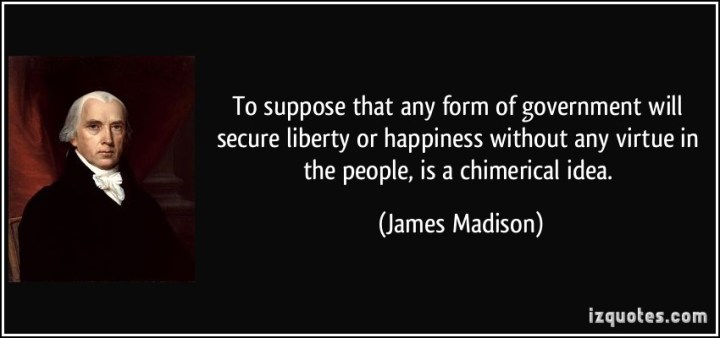
Madison wrote that “virtue is the vital principle of a republic, and it cannot long exist without frugality, probity, and strictness of morals.”[1]  Self-regulation was the key to living free.  Without a constancy of effort to live a life of virtuous moderation all would collapse into chaos and licentiousness.  If good behavior will not come from within, then it must come from an external source: government.

Virtue is so far gone from our modern theory of liberty that we no longer mourn the loss. We celebrate the unfettered expansion of personal choices while acquiescing to the fact that it has become the responsibility of an enlarged government to determine the limits.  The good life has been paradoxically both privatized and become the public responsibility.

In George Washington’s first inaugural address, he emphasized the vital connection between the public good and virtue.  He was confident that “no separate views or party animosities” would prevent them from forming national policy on “the pure and immutable principles of private morality.”[2]  According to Washington, America would win the respect of the world with the understanding that “there is no truth more thoroughly established than that there exists in the economy and course of nature an indissoluble union between virtue and happiness; between duty and advantage; between the genuine maxims of an honest and magnanimous policy and the solid rewards of public prosperity and felicity.”[3]

quote-to-suppose-that-any-form-of-government-will-secure-liberty-or-happiness-without-any-virtue-in-the-james-madison-117383

[1] James Madison, quoted in Michael J. Sandel, Democracy’s Discontent: America in Search of a Public Philosophy (Cambridge, Mass.: Belknap Press of Harvard University Press, 1996), 126.

[2] My Fellow Americans: Presidential Inaugural Addresses, from George Washington to Barack Obama (St. Petersburg, Fla.: Red and Black Publishers, 2009), 7.

[3] Ibid.


“There is seldom an Instance of a Man guilty of betraying his Country, who had not before lost the Feeling of moral Obligations in his private Connections.”

The narrative of American history has been a repudiation of the founder’s belief in limited government made possible by a virtuously self-regulating and public-spirited citizenry.  Gone from the political dialog is the irrevocable link between happiness and virtue.  It is the abandonment of the value placed on virtue that is particularly troublesome. As Sam Adams wrote in a letter to James Warren in 1775, “We may look up to Armies for our Defense, but Virtue is our best Security.  It is not possible that any State should long remain free, where Virtue is not supremely honored.”[1]

When it came to virtue, the founders did not believe that the private and the public were hermetically sealed off from one another.  In the same letter cited above, Adams wrote, “There are Virtues & vices which are properly called political. Corruption, Dishonesty to one’s Country, Luxury and Extravagance tend to the Ruin of States. The opposite Virtues tend to their Establishment…. Therefore Wise and able Politicians will guard against other Vices, and be attentive to promote every Virtue. He who is void of virtuous Attachments in private Life, is, or very soon will be void of all Regard for his Country. There is seldom an Instance of a Man guilty of betraying his Country, who had not before lost the Feeling of moral Obligations in his private Connections.”[2]

We are no longer concerned with what type of person is capable of participating in self-government.  Today the dialog focuses on whether the government allows each person enough liberty to make their own choices based upon personal values and their own self-established end states.  When the founders thought about liberty, the values were clearly established and the end state was well understood.  They debated sumptuary laws; we glorify excess.  Or as Aristotle might have put it, we have lost the habit of virtuous behavior.

            [1]  “Samuel Adams to James Warren – 1775,” Samuel Adams Heritage Society, last modified 2013, accessed September 4, 2016, http://www.samuel-adams-heritage.com/documents/samuel-adams-to-james-warren-1775.html.


                [2] Ibid.


                [3] Quoted in Carl J. Richard, Greeks and Romans Bearing Gifts: How the Ancients Inspired the Founding Fathers (Lanham, Md.: Rowman & Littlefield Publishers, 2008), 58-59.


Truth

“A Man must have a good deal of Vanity who believes, and a good deal of Boldness who affirms, that all the Doctrines he holds, are true; and all he rejects, are false.”[1]

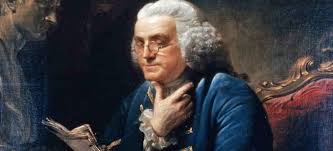
franklin

[1] From Benjamin Franklin to Josiah and Abiah Franklin, 13 April 1738,” Founders Online, National Archives, last modified June 13, 2018, http://founders.archives.gov/documents/Franklin/01-02-02-0037. [Original source: The Papers of Benjamin Franklin, vol. 2, January 1, 1735, through December 31, 1744, ed. Leonard W. Labaree. New Haven: Yale University Press, 1961, pp. 202–204.]

Words about a word

Words matter; and no words matter more than the ones that are meant to capture the most elusive and complex of our mental constructs.  The philosopher Isaiah Berlin wrote that “almost every moralist in human history has praised freedom.  Like happiness and goodness, like nature and reality, the meaning of this term is so porous that there is little interpretation that it seems able to resist.”[1]  One problem that is generally overlooked is that in typical usage the words liberty and freedom are used interchangeably, depending on how they seem to fit in the flow of a sentence.

In the Declaration of Independence the great verbal stylist Thomas Jefferson began with the claim that liberty was an inalienable right and closed with an assertion about a right to be free. Perhaps if the words are used in the same way they simply must mean the same thing.  While it is generally agreed that liberty and freedom are synonymous they have different origins.

A look back at the different experiences that these words were originally intended to capture provides credence to the theory of the four-note chord.  The fullest experience of liberty is not a solo experience.  Liberty originated from the Latin word libertas which meant unrestricted by restraint.  Freedom has an altogether different origin. It comes from a set of ancient northern European languages.  Whether it be the English word free, the Norse fri, the German frei, the Dutch and Flemish vrij, the Celtic rheidd, and the Welsh rhydd; they all have the same unexpected root.  They come down from the Indo-European priya, friya or riya, which meant dear, beloved, or friend.  To be free meant that a person was joined to a community of similar thinking people by ties of kinship and rights of belonging.[2]

It appears as though liberty and freedom, the two interchangeable words, may actually pull us in opposing directions.  The origin of liberty implied independence.  Freedom, on the other hand, involved connectedness.  However, these experiences do not need to cancel each other out.  The founders did not think so.  Their vision of a free society was not one where the personal, political and social were separate categories.  Personal independence functioned best within the context of community connections that nourished virtuous behaviors and wise political participation—the four-note chord.

 [1]  Isaiah Berlin, Isaiah Berlin: Two Concepts of Liberty (New York: Oxford University Press, 1969), 15, originally published 1969 as Four Essays on Liberty.

[2] David Hackett Fischer, Liberty and Freedom (Oxford: Oxford University Press, 2005), 5.


Good people make good laws. Laws can not make a people good.

My metaphor of a four-note musical chord is a new way of articulating a theory of liberty that resonated through so much of what the founders wrote.  Their political thought was a blend of utopian idealism and history-based realism.  Participatory government had everywhere failed.  In America it might be different.  On this “vast Continent unpeopled, with Every advantage of Clymate, Soil, and Situation, for the Accommodation of human Life and the Enjoyment of Liberty,” John Adams wrote, “Where Despotism and Superstition have not established their Thrones” an elevated spirit of public good that was morally and politically superior to individual needs and selfish passions should prevail.[1]

The political theorist Thomas Pangle wrote, “the American Founding came to be dominated by a small minority of geniuses who seized the initiative not merely by conciliating and reflecting common opinion but also by spearheading new or uncommon opinion.”[2]  What was particularly new and uncommon was their hope that a unique kind of liberty would take root, blossom, and flourish.  America provided a fresh start for humanity.  More personal and political liberty would be enjoyed by the citizens than at any previous time in history.  Individual state constitutions, the Articles of Confederation, and the Constitution all in turn spelled out how political liberty would be structured. The Bill of Rights protected personal liberty.  Yet much more was going to take place in this American experiment in good government.

The protection of personal and political liberty was not just the goal of government: it was the means to a grander end.  What I have identified as internal and public good liberty would thrive.  Citizens, both as voters and representatives, who had mastered the internal struggle against personal weaknesses and corruption would make wiser political decisions.  The goal of a minimally intrusive government could only be achieved through the promotion of this virtue-based liberty.  Citizens would understand that liberty was to be experienced not by everyone just “doing their own thing” within the boundaries established by law, but by learning to live virtuously, and by becoming more fully actualized human beings through commitment to the public good.

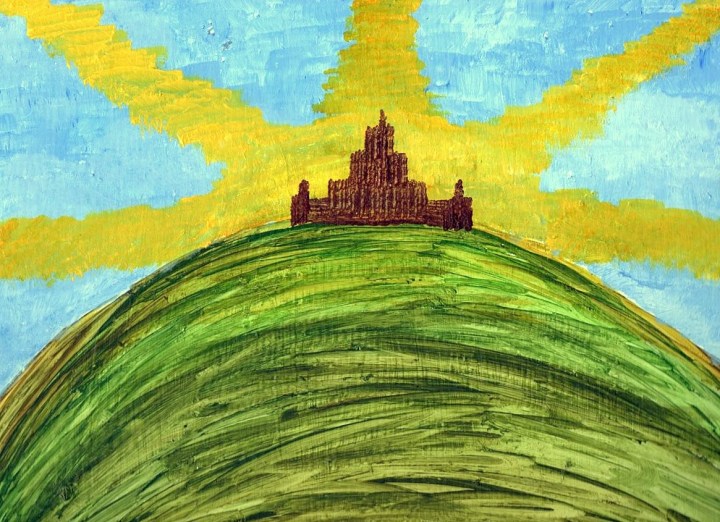
city

“We shall be as a City Upon a Hill,

the eyes of all people are upon us.”


[1] John Adams to Mathew Robinson-Morris, 14 March 1786, Writings from the New Nation 1784-1826, ed. Gordon S. Wood (New York: Library of America, 2016), 42.

[2] Thomas L. Pangle, The Spirit of Modern Republicanism: The Moral Vision of the American Founders and the Philosophy of Locke (Chicago: University of Chicago Press, 1988), 1.

The Education and Manners of the American People

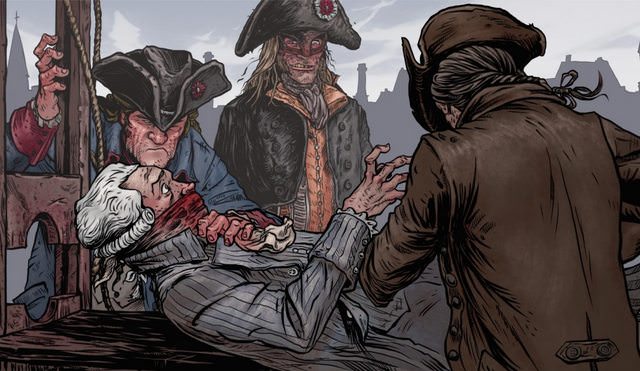
Serving as American Minister to France during the early years of the French Revolution, Gouverneur Morris observed the horrors that resulted from a people unable to handle liberty.  In a letter to Secretary of State Thomas Jefferson, he worried about the “instability of human Affairs especially of those which depend on the Opinion of an ignorant Populace…. Thank God we have no [rabble] in America and I hope the Education and Manners will long prevent that Evil.”[1]

terror

[1] “To Thomas Jefferson from Gouverneur Morris, 1 August 1792,” Founders Online, National Archives, last modified June 13, 2018, http://founders.archives.gov/documents/Jefferson/01-24-02-0255. [Original source: The Papers of Thomas Jefferson, vol. 24, 1 June–31 December 1792, ed. John Catanzariti. Princeton: Princeton University Press, 1990, pp. 275–277.]